
So the Pope has offered the blessing of same sex relationships—while still saying that same sex relationships are sinful. You can’t bless something with one hand and condemn it with the other.
This is more of the same homophobia with a slightly better public relations spin on it. A turd augmented with glitter.
Changing Paths challenge day 13 — things I do miss about my old path.
Unitarian hymns — specifically the earth-based ones like Peter Mayer’s “Blue Boat Home” (which doesn’t get sung often enough in the UK), “Mother Spirit” by Norbert Čapek, and nature-based ones like “Daisies are our silver” and “Spirit of Life” of course, but also some of the other ones like “Name Unnamed” which is beautiful. And I really appreciate how the Unitarians have defanged some of the classic Christian hymns by removing the obnoxious bits.
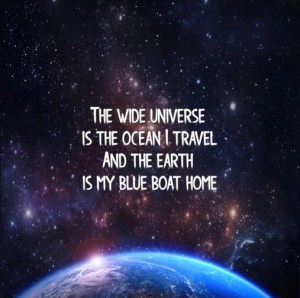
“The wide universe is the ocean I travel And the earth is my blue boat home” — UU poster by Gwinna
Blue Boat Home (tune: Hyfrydol) by Peter Mayer
Though below me, I feel no motion Standing on these mountains and plains Far away from the rolling ocean Still my dry land heart can say I’ve been sailing all my life now Never harbor or port have I known The wide universe is the ocean I travel And the earth is my blue boat home
Sun, my sail, and moon my rudder As I ply the starry sea Leaning over the edge in wonder Casting questions into the deep Drifting here with my ship’s companions All we kindred pilgrim souls Making our way by the lights of the heavens In our beautiful blue boat home
I give thanks to the waves upholding me Hail the great winds urging me on Greet the infinite sea before me Sing the sky my sailor’s song I was born upon the fathoms Never harbor or port have I known The wide universe is the ocean I travel And the earth is my blue boat home
The goal of the book is to help you decide your own path by guiding you through the perils and pitfalls of the terrain, and asking questions to help you deepen your understanding of the reasons for your desire to change paths.
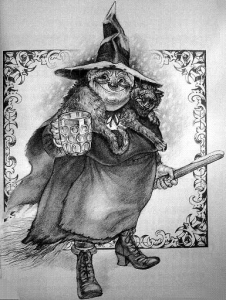
I left Unitarianism in the end because of archetypes. The archetype that fits me the best is that of the witch, and it’s an archetype that sits uncomfortably in the Unitarian path. (The combination may work for others: didn’t work for me.)
I left Christianity because of its exclusivist views on salvation and the institutional homophobia.
And when I left Paganism for a while in 2007, it was because of it being excessively heterocentric / heteronormative, and other reasons too lengthy to get into here.
However, at the end of the day, you have to pick something (could be atheism, could agnosticism, could be a religion or spirituality) and make it work for you. I chose inclusive polytheist Wicca.
I’m still friends with several Unitarians, either in person or on social media. Last September two of our longest-standing Unitarian friends from the UK came to visit us in Canada and we had a great time together. A quote from one of them found its way into the book too.
Although Unitarianism * / Unitarian Universalism wasn’t my path, I still value many of their ideas and values. They’re green, they’re LGBT+ inclusive or at least welcoming, they were the first to ordain women ministers (the Universalists in 1860, the English Unitarians in 1904), among the first to welcome LGBT+ people (1970 in the UK). Many 19th century Unitarian ministers were opposed to slavery, most notably Theodore Parker. They don’t believe in original sin. They frequently refer to God as She or Mother (and have done since the 19th century). They respect other faiths as valid paths to the divine. They characterize their path as a free and responsible search for meaning. They also have really nice hymns. And they welcome Pagans and have an organization for pantheist, Pagan, and Earth-based spirituality. Iolo Morgannwg, whose prayer is used by OBOD Druids, was a Unitarian. There are many connections between Unitarian and Pagan ideas.
* in the UK they’re called Unitarians; in the US they’re called Unitarian Universalists.
Why it wasn’t my path: it healed me of my wounds from Christianity, for which I am forever grateful; it’s a kinder, more rational, more liberal form of church—but despite the inclusion of ideas from other faiths, it still is a form of church.
The goal of the book is to help you decide your own path by guiding you through the perils and pitfalls of the terrain, and asking questions to help you deepen your understanding of the reasons for your desire to change paths.