Review of Changing Paths

A lovely review of Changing Paths by Jarred the Wyrd-Worker:

Yvonne Aburrow has provided a helpful guide for people who are considering leaving their religion and either finding a new spiritual home or abandoning religion altogether. Throughout the book, they offer guidance through the process, encouraging the reader to explore and understand what leaves them dissatisfied with their current religion and how another religious path (or even their current one) might address their needs that are being unmet.

Jarred Harris, review on Amazon

I particularly liked that Jarred noticed that I did not try to push the reader in any particular direction; some people might find fulfillment in atheism, or a different denomination of their existing religion, or within Paganism—but everyone’s different. I’m also glad he enjoyed the personal stories, especially the one about leaving Paganism.

Do check out the rest of the review on Amazon.

Available for purchase on all ebook formats

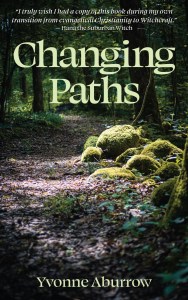
Changing Paths is now available for purchase in all major ebook formats!

Changing Paths – Universal Book Links Help You Find Books at Your Favorite Store

‎Changing Paths on Apple Books

Changing Paths on Google Play Bookstore

Kindle edition

Goodreads.com 🌍

Kobo edition

Stay tuned for the paperback announcement.

Changing Paths is published by 1000Volt Press and will be available as a paperback on April 11, 2023.

About the book

Are you entering Paganism, leaving Paganism, or changing traditions within it? How do you explain your new path to friends, family, former co-religionists, and yourself? How do you extricate yourself from your previous tradition and its associated ideas? How do you unpack your complex feelings about your path, and why you are changing direction?

If you have ever changed paths or considered changing paths, this book is for you. It is a guide for people who have entered Paganism from another tradition, people leaving Paganism for another tradition or none, and people changing from one tradition to another within Paganism.

Changing your religious or spiritual path can result in unexamined spiritual, emotional, and intellectual baggage from your previous tradition, which can cause all sorts of issues from depression to anger management. It can also be problematic when we bring this unexamined baggage to our new community and expect our new tradition to look like the one that we left. Many people, unless they have engaged in a very thorough deconstruction and reconstruction of their beliefs and attitudes, bring some of their views and expectations from their previous tradition into their new one.

This book will help you to navigate all the issues that arise from changing paths. It will help you to evaluate whether you should stay in or leave your current tradition. It explores what religions are, and how to evaluate and compare them. It will also be of interest to people seeking to understand the process of changing from one tradition to another, because a friend is going through that process. Although this book is mainly aimed at people entering or leaving Paganism, or switching to another Pagan tradition, it is also relevant to people switching between other traditions.

Each chapter includes journal prompts, questions for reflection, and exercises to help you navigate the terrain. There is also a list of further reading, and a bibliography, for any issues you want to follow up on. I hope that your journey will be less bumpy, and your landing softer, as a result of the signposts offered here.

One you have settled on your chosen community, staying in it can also be a challenge. Once the honeymoon period has worn off, what makes people stay in their new religious tradition? How do we resolve the conflicts we had with it in the first place? How do we reconcile with the fact that all religious communities have their internal divisions, and often contain people whose values are diametrically opposed to our own? Even if you leave religion altogether and become an atheist, you will encounter these difficulties in every community, whether it is your local pub or a roomful of atheists.

In the end, after all this upheaval, we have to get on with the business of living. We cannot live on the rarefied heights of spiritual experience all the time; other less intense experiences are available. Sometimes we need the steadying experience of being in community with others and doing comforting everyday things. These are also true and real and valuable. We do not always need to hack our own path up the mountain; we can grasp the handholds left by others along the way.