The Changing Paths challenge for May 2023. Feel free to skip a day or post something different from the topic of the day, but if you do the whole thing, I think you’ll arrive at a new perspective on your path.
Continue readingMonth: April 2023
“I won’t kneel for their god anymore”
James Gardner Davis has written an amazing reflection on changing paths in response to my guest appearance on the Missing Witches podcast.
Their candid discussion of how religious trauma is a catalyst for people to seek out more inclusive spaces, typically outside of Christianity, is so useful for so many people who are seeking out alternatives. I just felt so viscerally connected to that experience, having left the church due to it’s complicity in colonization, sexual abuse, and the truly incredible amounts of homophobic and patriarchal views. I, too, was taught liberation theology, but I really just want to be liberated from the dominant christian culture I am surrounded by.
James Gardner Davis, I won’t kneel for their god anymore
Do check out the whole post, it’s amazing.
Changing Paths is published by 1000Volt Press and is available from all the usual online stores. Ask your local bookseller or library to stock it!
The goal of the book is to help you decide your own path by guiding you through the perils and pitfalls of the terrain, and asking questions to help you deepen your understanding of the reasons for your desire to change paths.
Guest appearance on Missing Witches
I had the great pleasure of being interviewed on the Missing Witches podcast recently and they’ve just released the episode.
Patron deities
The concept of patron deities in polytheism caused me a lot of trouble back in the day. I was on a polytheist mailing list and it seemed like everyone on the list had a patron deity who had approached them personally. They were also adamant that the deity approached them and not the other way around. So I thought I should have a patron deity. This left me uniquely vulnerable to what happened next.
Continue readingReligion should be joyful
Paperback released today

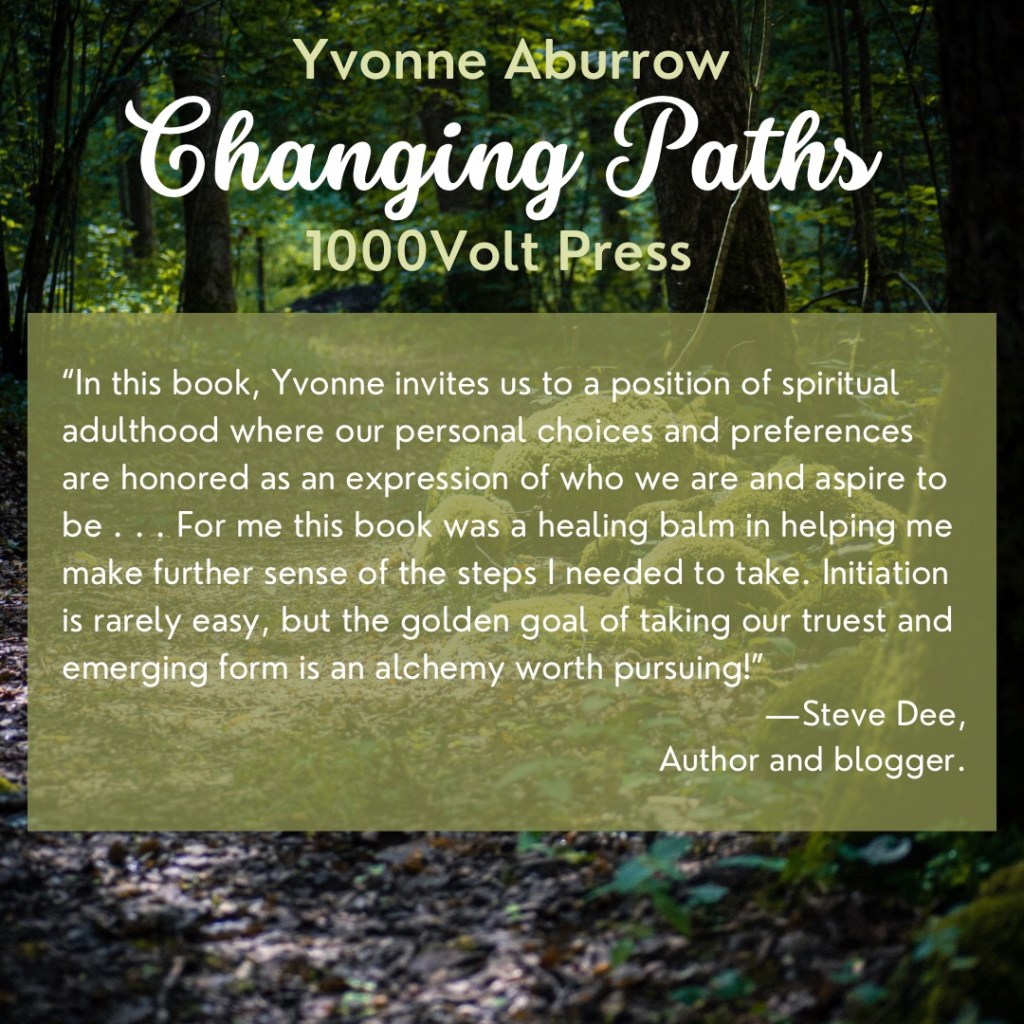
Review by Steve Dee
Changing paths survey
High glycemic religion
Religion can be divided into two types, high glycemic index and low glycemic index. High glycemic index gives you a big rush where everything seems really great and then you come down with a big crash afterwards. Low glycemic index is slow and steady, nourishes the soul, and keeps you going through the hard times.
Continue readingTheological questions
Readers of Changing Paths may wonder why I chose not to address theological questions like the existence of God, what happens in the afterlife, and related questions.
The first part of the book is aimed at people seeking to leave a variety of high-control traditions, which could be anything including fundamentalist Christianity, fundamentalist Islam, high-control new religions such as Scientology, and even high-control versions of Paganism.
For each of these traditions, the theological arguments are different, so rather than devote a large amount of space to them in the book, or write yet another book about why a supreme creator deity does not exist, I wanted to write about extricating yourself psychologically from harmful religious traditions.
Continue reading Changing Paths